
Fog on a Permian Basin farm road at 5 a.m. A brown wall of dust rolling across I-20 west of Odessa. Wildfire smoke drifting in from New Mexico. Oncoming glare on a wet two-lane at night with an oilfield convoy coming the other way. Low visibility in West Texas is not one condition, it is four or five, and they arrive without much warning.
Whatever the cause, the problem is the same: you cannot see far enough ahead to detect a hazard, decide what to do, and stop smoothly. This guide walks through how to set a safe speed from what you can see, how to use the 3/6-second rule to hold space, which lights help and which hurt, and how to make the call to pull off when the math says stop. It applies whether you are in a loaded tractor-trailer or a pickup on the way to a well site.
What actually counts as low visibility
Forget the number on the weather report. The practical test is simple: if your clear sight line is shorter than the distance you need to stop on this surface, you are in low visibility. That can happen at 500 feet in dense fog, or at a quarter mile in blowing dust when the road is also slick.
The conditions that trigger it most often around Midland and Odessa:
- Dense morning fog in low spots and along the draws, especially after a rain
- Dust storms that drop visibility to a few car lengths in seconds
- Wildfire or grass-fire smoke sitting on the road in still air
- Heavy rain and truck spray that wipe out contrast and depth cues
- Night glare from oncoming headlights on wet pavement
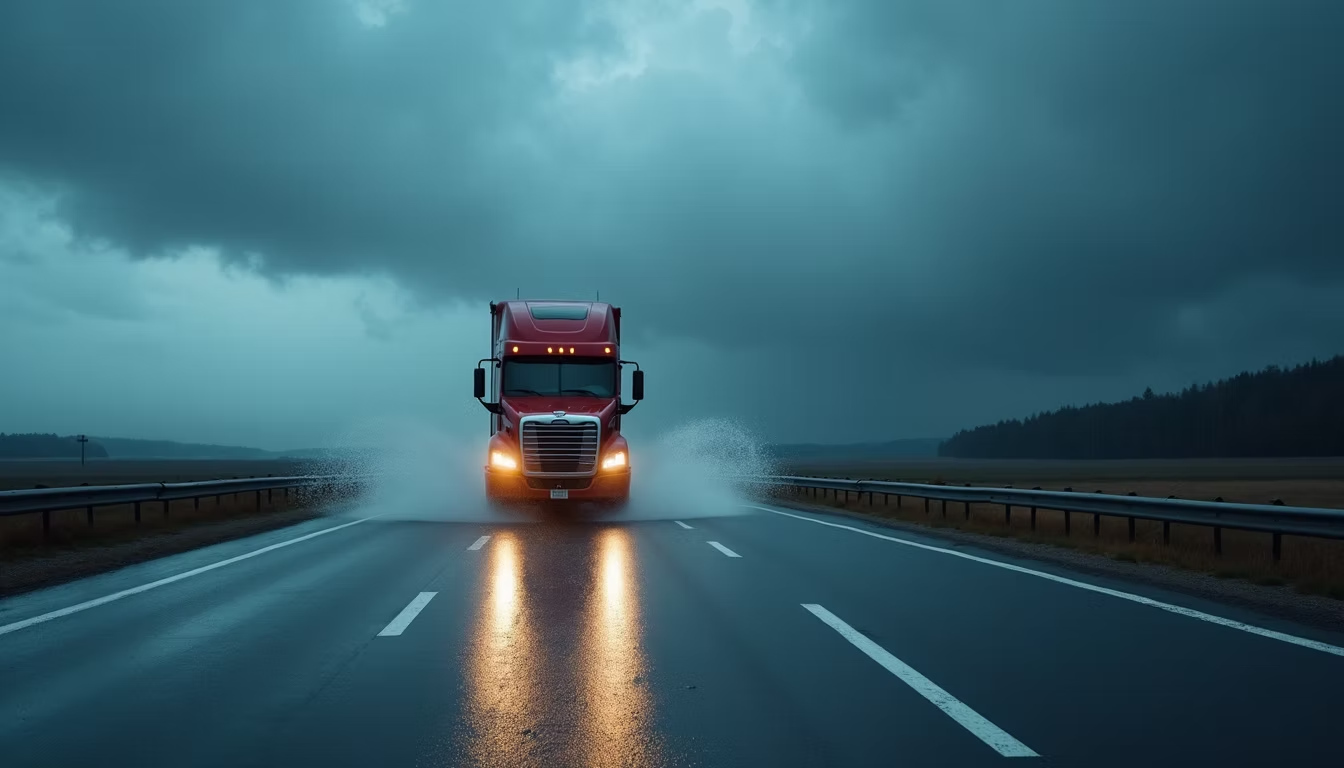
The physics behind safe speed and space
Stopping distance has two parts. Thinking distance is how far you travel before you react, and it grows in a straight line with speed. Braking distance is how far you travel once the brakes are on, and it grows with the square of speed. Double your speed and your braking distance roughly quadruples on the same surface. Wet, dusty, or icy pavement gives you less friction, so both numbers get worse at the same time.
That is why the posted limit stops mattering in poor visibility. Your safe speed is the one where your total stopping distance fits inside what you can see. If the sight line shrinks, the speed has to come down with it. We cover the full mechanics of friction, weight transfer and stopping distance in The Physics of Safe Driving.
The 3/6-second rule
Time-based following distance adapts to conditions and to your vehicle in a way that car-lengths never will.
- Light vehicles in good conditions: hold at least 3 seconds behind the vehicle ahead.
- Commercial vehicles, or anyone in poor conditions: stretch it to 6 seconds or more.
Pick a fixed roadside marker such as a sign post or a mile marker. When the vehicle ahead passes it, start counting one-thousand-one, one-thousand-two. If you reach the marker before you finish the count, drop back. In fog, smoke, rain or glare, add time on top of that, because you are giving up both visibility and traction at once. In a loaded combination vehicle with air brakes, bias toward the longer interval every time. Following distance and controlled braking get their own treatment in the Professional Driving Excellence and Adverse Weather Operations course.
Sight lines and lane discipline
Your hands follow your eyes, so in low visibility you narrow your scan to the things you can actually confirm. Anchor on the right-side fog line for lane position, use the centerline reflectors to read curvature, and keep deliberate mirror checks going for traffic closing from behind and for spray.
Stay off the centerline when you can. That is where oncoming glare and cross-traffic risk are highest. Track the right edge when it is safe, and skip lane changes you do not need. Other drivers cannot see you any better than you can see them.
Lighting that helps, and lighting that hurts
- Low beams in fog, dust and heavy snow. High beams bounce off the particles and come straight back at you, killing contrast.
- Fog lamps, if you have them, aim low and wide and paint the lane edges.
- Headlights on in rain, even in daylight. Texas law requires it when wipers are in use, and it is the main way other drivers spot you in spray.
- Dim the cab. Bright screens and interior lights shrink your pupils and wreck your night adaptation.
- Wipers and defog early, before the windshield and mirrors glaze over.
Using hazard flashers correctly
Hazards are a warning that you are moving well below the flow, or that you are stopped or nearly stopped on the roadway. They are not a substitute for driving at the right speed, and cruising at normal speed with them on tells the driver behind you nothing useful about what you are doing.
If a dust wall or a fog bank forces a hard slowdown, tap the brakes early so the lights wake up following traffic, then add hazards until you are back to a predictable speed or fully off the road.
Traction and hydroplaning
On wet pavement a thin film of water is enough to lift the tire off the surface. Higher speed, wider tires and light loads all make it more likely. Slow down before standing water, keep steering and brake inputs smooth, and avoid sudden throttle changes that shift weight and break traction. In dust or ash, treat the surface like fine snow: gentle inputs and long distances. The warning signs are covered in detail in How to Drive on Black Ice Safely, and most of them apply to any loose surface.
When to pull off, and how
If you can no longer keep your full stopping distance inside your sight line at any reasonable speed, the drive is over for now. Do it in this order:
- Signal early, ease off the throttle, and hold your lane.
- Pick a real refuge: a rest area, an exit, or a wide shoulder well clear of the travel lanes. Not a narrow shoulder and never a live lane.
- Pull all the way right, angle slightly away from traffic, set hazards, and use parking lights. Not high beams, which can pull a disoriented driver straight toward you.
- In a commercial vehicle, set your triangles per regulation. If exposure risk is high, stay belted in the cab.
Get back on the road only when you can see far enough to hold the 3/6-second cushion at a sensible speed.
Three myths worth dropping
- “High beams help in fog.” They do the opposite. Backscatter makes the glare worse.
- “Just follow the taillights ahead.” You inherit every mistake that driver makes, and you can run straight into a stopped vehicle you never saw.
- “The posted limit still applies.” It is a maximum for ideal conditions. Your limit is what the surface and the sight line allow.
Why this matters for fleets
Rear-end collisions and lane departures are the two most common low-visibility crash types, and both are almost entirely preventable with consistent habits. Drivers who tie speed to sight distance, stretch their time gap and use lighting correctly have fewer near-misses and fewer roadside stops, which means fewer secondary collisions and a much easier conversation with the insurer afterward. Our Commercial Driver Safety Training is built to make those habits the same across every driver in the yard.
Frequently asked questions
What is considered low visibility for driving?
Any time your clear sight line is shorter than your total stopping distance at your current speed. Fog, smoke, dust, heavy rain and night glare are the usual causes.
Should I use hazard flashers in fog?
Only when your speed is well below the flow of traffic, or when you are stopped or nearly stopped. Do not drive at normal speed with them on.
What is the 3/6-second rule?
Hold at least 3 seconds of following distance in good conditions in a light vehicle, and 6 seconds or more in a commercial vehicle or in poor conditions, then add more as visibility or traction gets worse.
What is hazard perception training?
Training that builds the habit of spotting a developing risk early and acting before it becomes an emergency. In low visibility that means reading sight lines, recognizing backscatter and glare, anticipating sudden slowdowns, and adjusting speed and space before you are forced to.
Turn it into habit
Low-visibility driving rewards restraint and smooth inputs more than anything else. Tie your speed to what you can see, stretch your cushion, use the right lights, and stop when the numbers stop working. If you want structured practice at those decisions, the adverse weather operations course covers low visibility alongside ice, snow and high wind for commercial drivers, and Passenger Vehicle Operations in Adverse Weather teaches the same skills for a car, pickup or SUV. Questions about which one fits? Get in touch or go straight to registration.