
The Rules Exist Because the Stakes Are Real With Commercial Motor Vehicle Safety
Commercial trucking moves the American economy, literally. It requires some of the largest, heaviest vehicles on the road alongside passenger cars, cyclists, and pedestrians. That reality is why the trucking industry operates under one of the most comprehensive safety regulatory frameworks of any profession in the United States.
For professional drivers, safety standards aren’t bureaucratic red tape. They’re a cornerstone of the career. Knowing the federal rules and building the skills to follow them in real-world conditions is what separates drivers who last in this industry from those who don’t.
At Excell PDT, we help professional drivers go beyond basic compliance with advanced online driving courses. Because knowing the rules and having the skills to execute them under pressure is absolutely essential.
Organizations That Set the Standards For Commercial Truck Drivers
Safety in commercial trucking is regulated at both the federal and state level, with primary oversight coming from the Federal Motor Carrier Safety Administration (FMCSA), a branch of the U.S. Department of Transportation. The FMCSA establishes the minimum standards every commercial motor vehicle (CMV) operator must follow. State agencies then enforce those standards and, in some cases, add requirements of their own.
For professional drivers, the FMCSA’s regulations touch nearly every aspect of the job from how many hours can be driven in a day to how cargo must be secured to the specific endorsements required to carry certain types of loads.
Understanding where these rules come from helps drivers treat compliance not as an obligation to work around but as a professional standard to uphold.
The Key CSA Safety Standards Every Professional Driver Must Know
Here’s a closer look at the CSA compliance, safety and accountability standards:
Hours of Service (HOS) Regulations
Hours of Service rules govern how long a commercial driver can operate a vehicle before mandatory rest periods are required. The core limits under current FMCSA regulations include:
- Maximum of 11 hours of driving after 10 consecutive hours off duty
- 14-hour on-duty window within which all driving must occur
- 30-minute break requirement after 8 hours of driving
- 60/70-hour limit on total on-duty time across 7 or 8 consecutive days
HOS regulations are enforced through Electronic Logging Devices (ELDs), which are now mandatory for most CMV operators and provide a tamper-resistant record of driving time. These rules exist because fatigue is one of the leading contributors to commercial vehicle accidents.
Commercial Driver’s License (CDL) Requirements and Endorsements
Operating a commercial motor vehicle requires a valid CDL — but the specific license class and endorsements required depend on the vehicle and the cargo. Class A licenses cover combination vehicles with a gross combined weight rating over 26,001 pounds. Class B covers single vehicles over 26,001 pounds. Beyond the base license, specific endorsements are required for hauling hazardous materials, operating tank vehicles, pulling doubles or triples, or transporting passengers.
Maintaining a valid CDL in good standing isn’t just a legal requirement. It’s the professional credential that a driver’s entire livelihood depends on.
Pre-Trip and Post-Trip Vehicle Inspections
FMCSA regulations require commercial drivers to conduct a systematic inspection of their vehicle before and after every trip. The pre-trip inspection covers:
- Brakes
- Tires
- Lights
- Steering
- Mirrors
- Cargo securement
- Coupling devices
- Emergency equipment
Drivers must complete and sign a Driver Vehicle Inspection Report (DVIR) documenting the condition of the vehicle. This requirement exists because mechanical failure is a leading cause of commercial vehicle accidents. A brake defect identified in the yard is a problem. The same defect discovered at 60 mph on a mountain grade is catastrophic.
Electronic Logging Device (ELD) Compliance
ELDs replaced paper logbooks and are now mandatory for most commercial drivers. These devices automatically record driving time, engine hours, vehicle movement, and location data. They are directly connected to the vehicle’s engine to prevent manual manipulation of records.
ELD compliance is not optional. Violations identified during roadside inspections can result in drivers being placed out of service immediately, regardless of where they are or what cargo they’re carrying.
Drug and Alcohol Testing
The FMCSA mandates drug and alcohol testing programs for all CDL holders. Testing occurs during:
- Pre-employment
- Randomly throughout employment
- Following any accident that meets specific criteria
- When there is reasonable suspicion of substance use
- Upon return to duty after a violation
Commercial drivers are subject to a zero-tolerance standard for alcohol while on duty. Any driver found in violation is immediately removed from safety-sensitive functions. A positive drug test triggers a mandatory referral to a Substance Abuse Professional and a return-to-duty process before a driver can operate a CMV again.
Cargo Securement Standards
How a load is secured is not left to individual driver judgment. FMCSA regulations specify minimum requirements for the number and placement of tie-downs, the working load limits of securement equipment, and the specific requirements for different cargo types including lumber, metal coils, automobiles, and intermodal containers.
An improperly secured load doesn’t just endanger the driver. Cargo that shifts during transit can cause loss of vehicle control. Cargo that escapes the vehicle entirely becomes a lethal hazard for every other road user in its path.
Weight and Size Limits
Federal law limits commercial vehicles to 80,000 pounds gross vehicle weight on the interstate highway system, with specific axle weight limits that distribute that load safely across the vehicle’s structure. Width, height, and length limits also apply, with oversize or overweight loads requiring special permits, escorts, and route pre-approval in many states.
Exceeding these limits doesn’t just put you at risk for a citation. It can cause catastrophic structural failure of bridges and roadways, loss of vehicle control, and accidents that can involve multiple vehicles.
Speed and Safe Following Distance
Many states set lower speed limits specifically for commercial vehicles, and FMCSA regulations require drivers to maintain safe following distances appropriate to the size and weight of their vehicle. The general rule is one second of following distance for every 10 feet of vehicle length, plus an additional second at speeds above 40 mph.
In adverse weather conditions, those distances must increase substantially. A loaded semi traveling at highway speed in normal conditions may need more than 400 feet to stop. Driving a commercial vehicle on ice or packed snow, that distance can multiply several times over.
Hazardous Materials Regulations
Drivers transporting hazardous materials operate under an additional layer of federal regulation managed jointly by the FMCSA and the Pipeline and Hazardous Materials Safety Administration (PHMSA). HazMat regulations govern placarding requirements, route restrictions, documentation, emergency response information requirements, and the specific handling procedures for different classes of hazardous material.
HazMat endorsement holders carry an additional level of responsibility and face additional scrutiny from both enforcement agencies and the public.
The Repercussions For Truck Drivers That Fail to Follow Safety Standards
Failing to meet safety standards in commercial trucking carries consequences that extend across a driver’s career, a carrier’s operation, and in the worst cases, innocent people’s lives.
Out-of-Service Orders
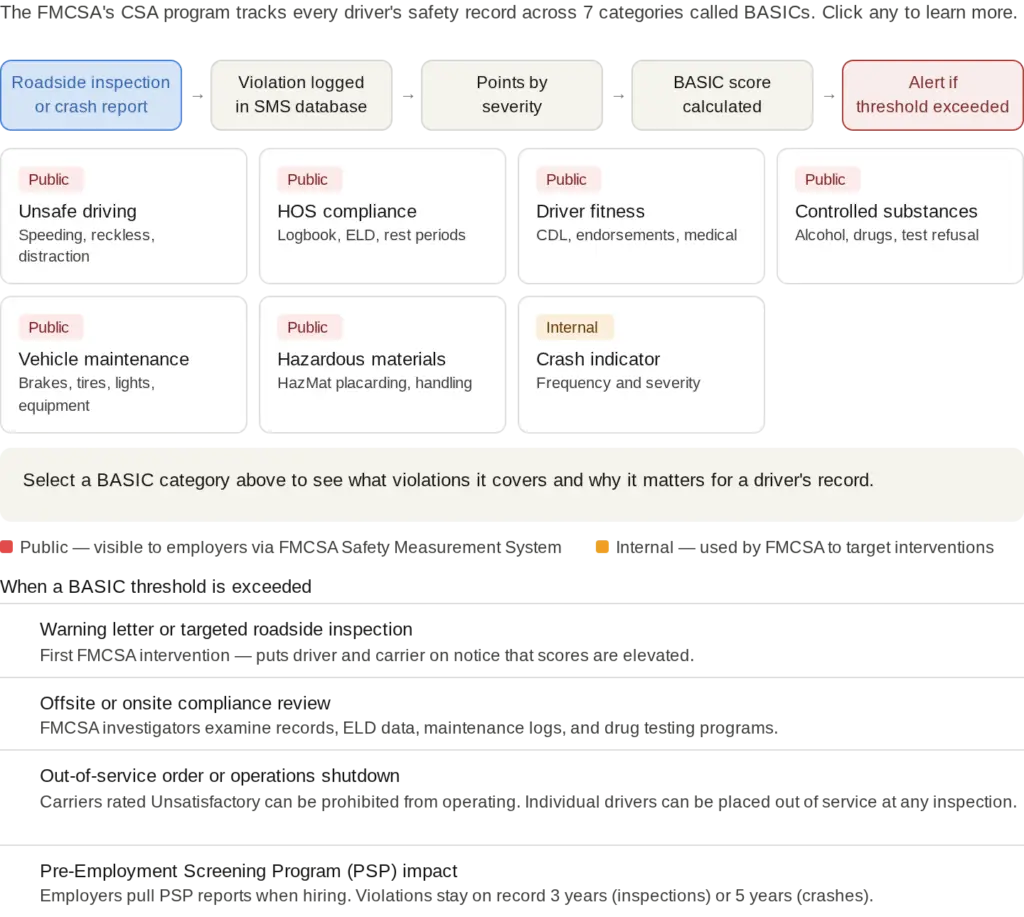
When a driver or vehicle is found to be in violation of safety regulations during a roadside inspection, FMCSA inspectors have the authority to place that driver or vehicle out of service immediately. An out-of-service order means operations stop right there, regardless of schedule, cargo, or deadline. The driver cannot legally operate the vehicle until the violation is corrected and the order is lifted.
CSA Scores and Driver Pre-Employment Screening
The FMCSA’s Compliance, Safety, Accountability (CSA) program tracks safety violations and inspection results then assigns scores to both carriers and individual drivers. High CSA scores signal elevated safety risk and are connected to a driver through the Pre-Employment Screening Program (PSP), which prospective employers check when evaluating candidates.
A pattern of violations, even relatively minor ones, can make a driver significantly harder to hire and may disqualify them from positions with carriers that have strict safety standards.
CDL Suspension and Revocation
Serious violations can result in CDL suspension or permanent revocation. A DUI conviction in any vehicle — not just a commercial vehicle — can affect your ability to have a valid CDL. Certain offenses, including operating a CMV under the influence, leaving the scene of an accident involving a CMV, or using a CMV in the commission of a felony, result in mandatory CDL disqualification. Some offenses carry lifetime disqualification.
For a professional driver, losing a CDL isn’t a setback. It’s the end of their career.
Civil Liability and Litigation
When a commercial vehicle accident results in injuries or fatalities, the legal scrutiny that follows is intensive. Violations of FMCSA safety regulations at the time of an accident create significant civil liability exposure for both the driver and the carrier. Attorneys representing injured parties routinely subpoena ELD records, inspection reports, drug testing records, and maintenance logs. A pattern of non-compliance discovered after an accident substantially increases both liability and settlement exposure.
Carrier Safety Ratings and Operational Shutdowns
FMCSA safety ratings are public record. An Unsatisfactory rating can prevent a carrier from operating entirely. For drivers employed by a carrier whose safety rating deteriorates, the consequences can include job loss, operational disruptions, and reputational damage that affects future employment prospects.
The Human Cost
Every safety regulation in commercial trucking exists because someone was injured or killed before the rule was written. The FMCSA estimates that large trucks are involved in tens of thousands of crashes annually, with thousands of fatalities. Non-compliance doesn’t just result in a citation. It can mean being the driver whose vehicle is involved in a preventable accident that changes or ends lives forever.
That risk is not abstract. It is real, documented, and preventable.
Compliance is the Floor, Not the Ceiling
Regulatory compliance sets the minimum bar. It tells a driver what they must do to legally operate on public roads. It does not tell a driver what they need to do to be genuinely safe in all the conditions the road will throw at them.
A driver can be fully compliant with every FMCSA regulation and still be dangerously unprepared for a black ice crossing in a mountain pass, a sudden stop on a rain-soaked highway, or a load shift on a steeply graded descent. Compliance ensures a driver is legal. Advanced skills and knowledge ensure a driver is safe in all situations.
How Excell PDT Helps Professional Drivers Stay Safe and Compliant
Physics-Based Skills That Go Beyond the Rulebook
Understanding what the regulations require is necessary. Understanding why the regulations exist is what makes a driver genuinely safer. That question is answered by understanding the physics of driving – braking, momentum, weight distribution, and friction. Excell PDT courses teach the science behind safe driving so drivers can apply the right techniques even in situations they didn’t anticipate.
Specialized Training For the Conditions That Cause the Most Accidents
Many of the most serious commercial vehicle accidents happen in adverse weather conditions. Unfortunately, these are the conditions that standard driver training addresses the least. Excell PDT specializes in winter weather driving, equipping professional drivers with the skills to operate safely on ice, snow, and in reduced visibility where the margin for error is smallest.
Continuing Education That Keeps Skills Current
The FMCSA requires ongoing compliance, but regulations evolve and road conditions change. Excell PDT continuing education courses are designed specifically for working commercial drivers who need to sharpen their existing skills and add new ones without disrupting their schedules. Online course formats allow drivers to complete training at their own pace, on their own time.
Documentation of Training That Supports a Driver’s Professional Record
Completing Excell PDT courses provides verifiable evidence of professional development. In an industry where CSA scores and pre-employment screening are routine, documented training reflects a driver’s commitment to safety and can strengthen their standing with current and prospective employers.
Preparation That Reduces Risk Before It Becomes a Violation
Excell PDT training is built around prevention: giving drivers the tools to recognize risk, manage challenging conditions, and make sound decisions before a situation becomes an emergency.
Special Trucking Safety Services For Fleet Operators and Safety Managers
Safety compliance is not just a driver responsibility. It’s an organizational one for fleet operations. Carriers that invest in driver education beyond minimum compliance requirements see measurable results in the form of fewer accidents, better CSA scores, lower insurance costs, and a stronger safety culture that attracts and retains high quality drivers.
Excell PDT offers group training options for fleets and organizations that want to bring physics-based driving education to their entire driver workforce. Contact our team to discuss how we can tailor a training program to your operation’s specific needs and routes.
Excell PDT is here to help you improve safety with education that goes beyond compliance to give you the skills, knowledge, and confidence to navigate every road, in every condition.
Explore Excell PDT Courses For Commercial Drivers →