This module covers the physical laws that govern every bus on the road — inertia, force and momentum, and weight transfer — and connects them to following distance, friction, the real crash risk of rain, and how to prevent and recover from hydroplaning.
The Physics That Never Change
Now we turn to the physics that never change. Kinetic energy, friction, and following distance do not care what you are driving or how experienced you are. A bus is heavy, its momentum is real, and its tires can only grip the surface they are given. In the next section, we will connect those facts to the choices you make behind the wheel, how early you brake, how much space you keep, and how you respond when rain, snow, or ice reduces your margin for error.
The Laws That Govern Every Bus on the Road
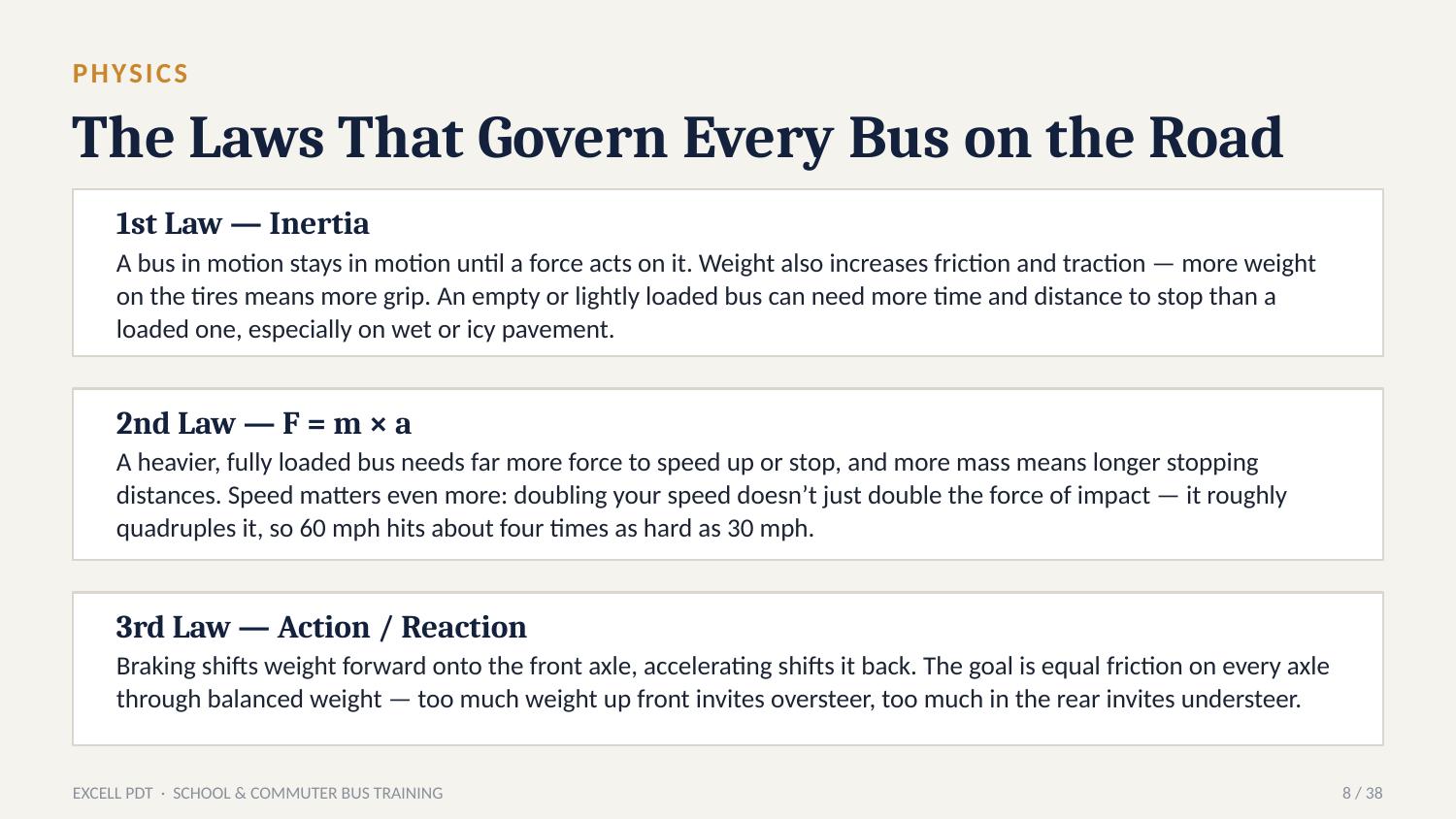
Three laws govern every bus on the road. Newton’s first law is inertia. A bus in motion stays in motion until a force acts on it. Weight also increases friction and traction, since more weight pressing down means more grip on the road. That means an empty or lightly loaded bus can actually need more time and distance to stop than a loaded one, especially on wet or icy pavement. Newton’s second law is force equals mass times acceleration.
A heavier, fully loaded bus needs far more force to speed up or stop, and more mass means longer stopping distances. Speed matters even more than mass. Doubling your speed doesn’t just double the force of impact, it roughly quadruples it, so 60 miles per hour hits with about four times the force of 30. Newton’s third law is action and reaction. Braking shifts weight forward onto the front axle, and accelerating shifts it back.
The goal is equal friction on every axle through balanced weight distribution. Too much weight up front invites oversteer, and too much weight in the rear invites understeer.
Following Distance and Friction Are Your Margin
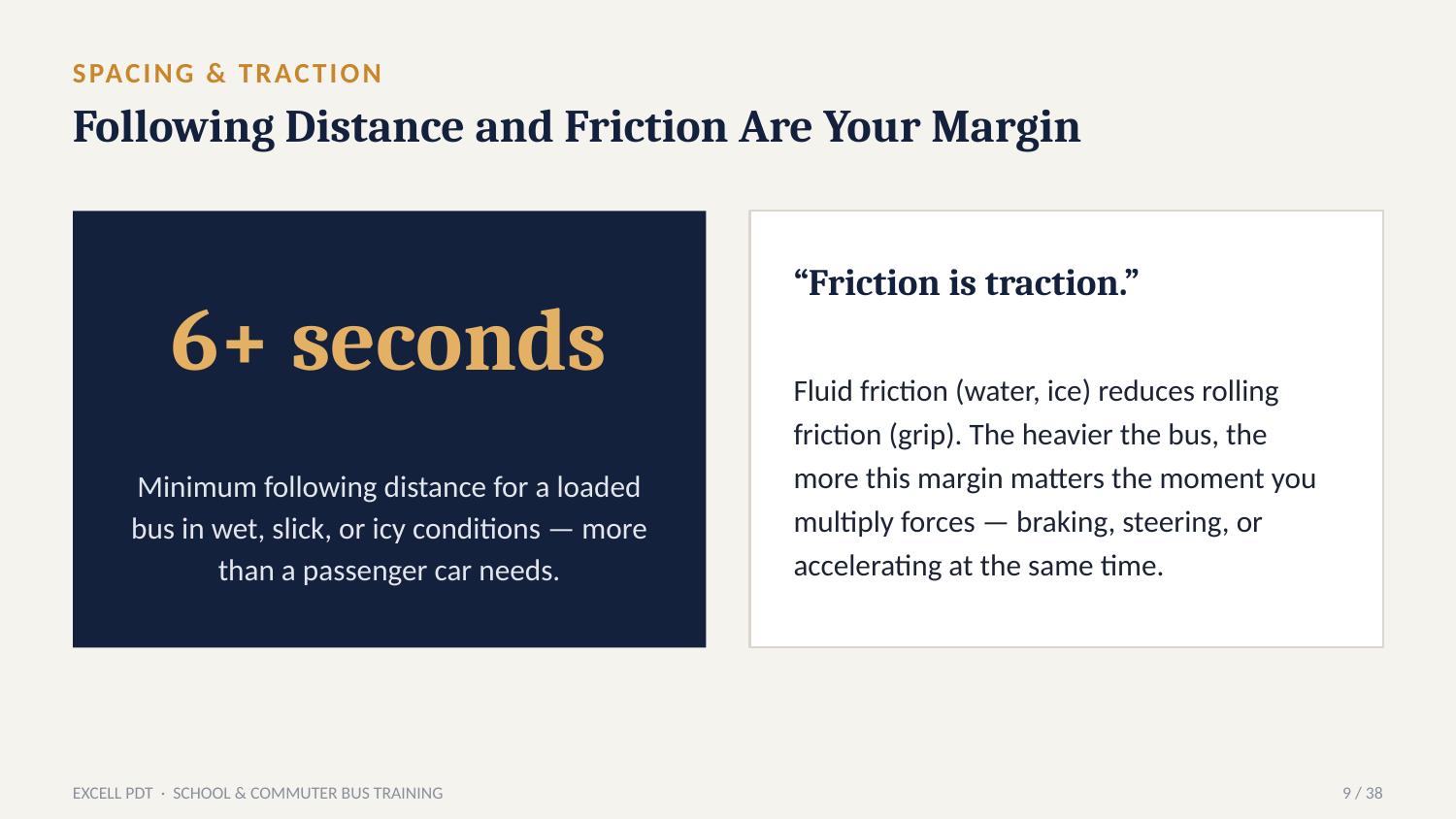
Following distance and friction are the margin that gives you options. In wet, slick, or icy conditions, a loaded bus needs a minimum following distance of 6 seconds or more. That is more space than a passenger car needs, because your bus carries more mass and needs more time to respond. Remember that friction is traction. Water and ice create fluid friction and reduce the rolling friction or grip available at the tires.
The heavier the bus, the more that lost margin matters when you multiply forces by braking, steering, or accelerating at the same time. Build space early so you are not forced into sudden inputs later.
Rain Kills More Drivers Than Snow or Ice
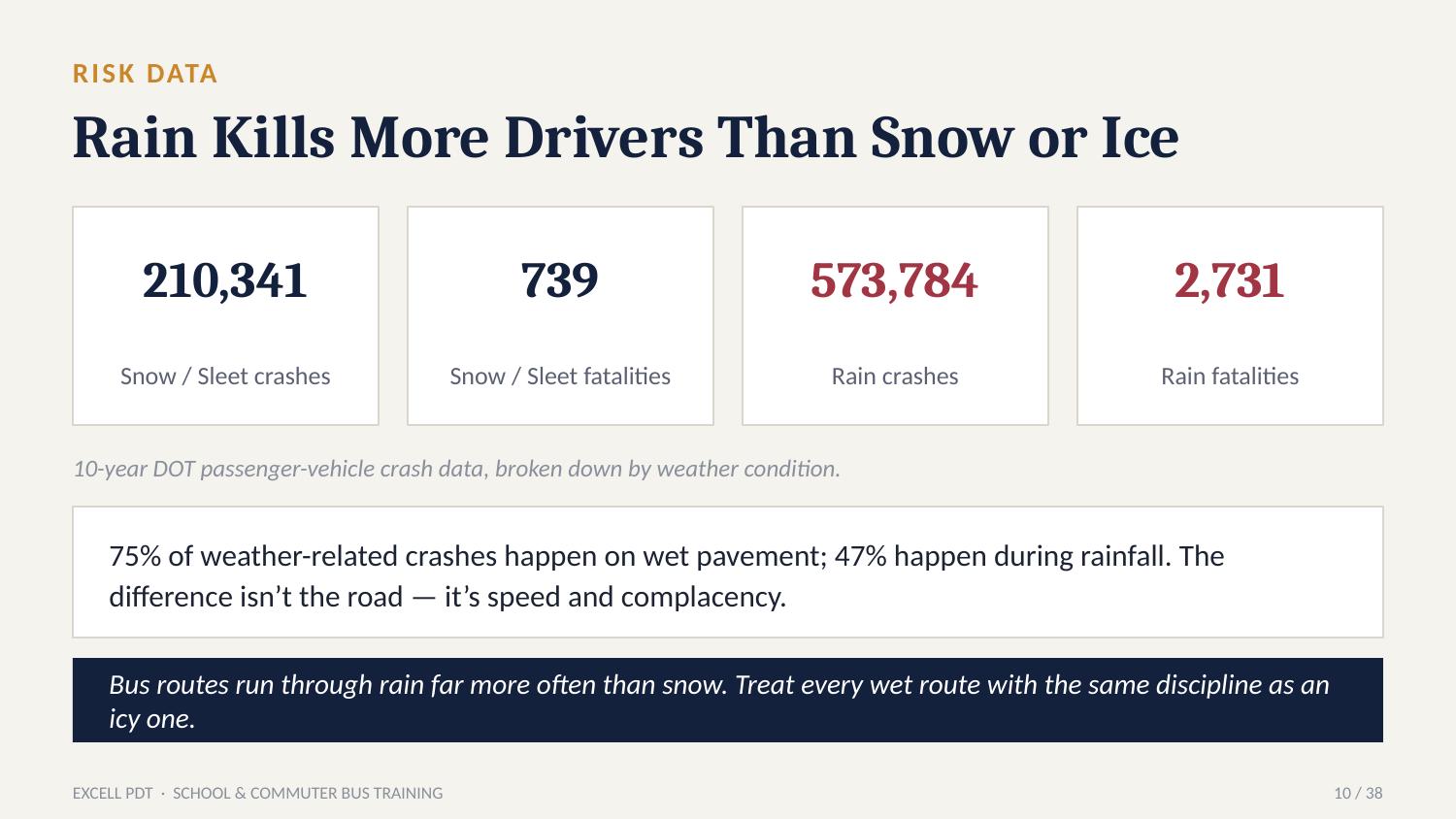
Rain deserves the same respect drivers often reserve for snow and ice. Ten-year DOT passenger vehicle crash data lists 210,341 snow or sleet crashes and 739 snow or sleet fatalities. For rain, the figures are 573,784 crashes and 2,731 fatalities. 75% of weather related crashes happen on wet pavement and 47% happen during rainfall. The difference is not just the road. It is speed and complacency.
Bus routes run through rain far more often than snow, so a wet route is not routine simply because it is familiar. Treat every wet route with the discipline you would bring to an icy one.
Hydroplaning Can Happen to a Bus Too
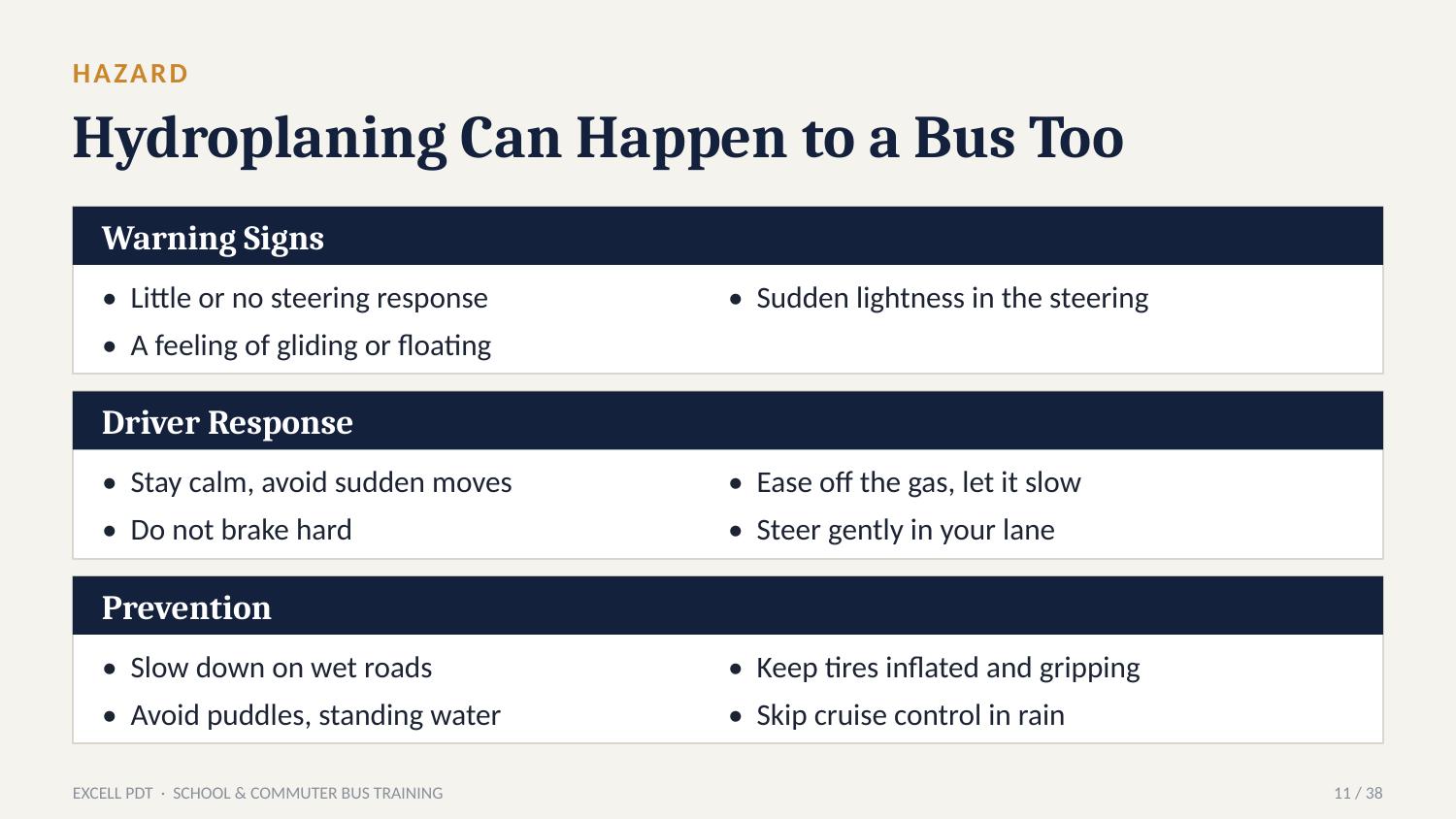
Hydroplaning can happen to a bus, too. Watch for little or no steering response, sudden lightness in the steering, or the feeling that the bus is gliding or floating. If it happens, stay calm and avoid sudden movements. Ease off the gas and let the bus slow down. Do not brake hard and steer gently while keeping the bus in its lane. Prevention starts before the tires lose contact with the road.
Slow down on wet roads, keep tires properly inflated and able to grip, avoid puddles and standing water, and skip cruise control in rain. Smooth control protects your traction and gives the tires time to regain the surface.