Master Steep Mountain Roads to Drive Safer in Any Vehicle
Experienced drivers respect mountain roads. That’s not a coincidence. The drivers who’ve spent real time on steep grades know that experience alone doesn’t protect you — knowledge does. A wrong decision on a 6% downgrade at highway speed isn’t a fender bender. It’s a runaway truck. It’s a jackknife. It’s a life-altering event for you and other drivers in your path.
Mountain passes and steep grades are among the most unforgiving environments a commercial driver will ever face. The physics are extreme. The consequences of an error are severe. And the margin for a mistake is smaller than anywhere else on the road.
At Excell PDT, we teach professional drivers what the mountain demands so they’re never caught unprepared when the road starts to descend, there’s a narrow road with no shoulder or uphill traffic to battle in a big rig.
Why Training For Mountain Driving is Different Than Everything Else
Most of what a driver learns in standard training applies to flat or gently rolling terrain. The braking distances, speed management and lane changes are taught with relatively stable conditions in mind. Mountain driving changes the equation in ways that most training programs never address.
On a steep grade, you’re no longer just managing your vehicle. You’re managing the forces your vehicle generates as it responds to elevation change, gravity, and in winter conditions, dramatically reduced traction. Those forces compound quickly and you can’t correct them by simply driving slower. A mistake that would be easily corrected on flat ground can become unrecoverable on a mountain pass.
The drivers who navigate mountain roads safely aren’t fearless. They’re prepared. They’ve studied the dangers, they understand the physics, and they know the techniques that keep a commercial vehicle under control when the road’s steepness can be dangerous.
The Specific Dangers of Mountain Roads and Steep Grades
Runaway Vehicles and Brake Failure
Brake failure on a steep downgrade is one of the most catastrophic events in commercial trucking. It doesn’t happen suddenly. It builds with each mile.
Overheated brakes lose their ability to generate friction. The vehicle that felt controllable at the top of a grade can be completely out of control by the bottom. This is why runaway truck ramps exist on major mountain highways. They’re not a last resort for careless drivers. They’re infrastructure components built specifically because brake fade is a known, predictable danger that even experienced drivers can underestimate.
Understanding brake temperature, proper downhill gear selection, and the signs of brake fade before it becomes brake failure is not optional knowledge for drivers that are navigating mountain terrain. It’s essential knowledge.
Grade Percentages and What They Actually Mean
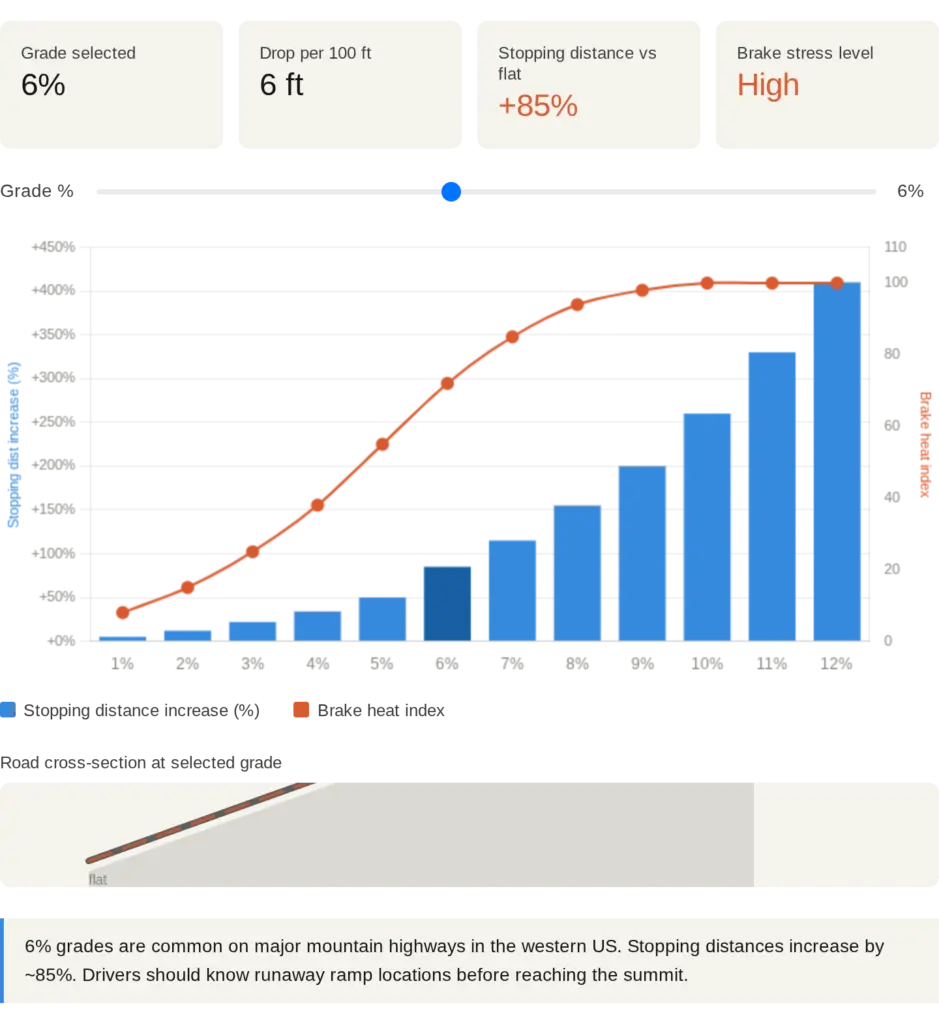
A 6% grade means the road drops 6 feet for every 100 feet of horizontal distance. That sounds modest, but for a loaded 80,000-pound semi, it can be hazardous. Grades of 6–8% are common on major mountain highways in the western United States. Grades exceeding 10% exist on certain routes. Every percent of grade increases the gravitational pull on your vehicle and reduces the margin your brakes have for managing speed.
Most drivers understand that steep grades require more caution. Fewer understand exactly how much more, and that’s the gap that causes accidents.
Jackknifing and Loss of Trailer Control
Jackknifing occurs when a trailer swings out of alignment with the cab, typically caused by the drive wheels locking up or by improper braking on a descent. On a mountain grade, where braking demands are higher and road surfaces may be compromised, the risk is significantly elevated. Once a jackknife begins, the window for recovery is very narrow. Prevention through proper speed management, gear selection, and braking technique is the only reliable strategy.
Tire Blowouts on Descents
Heat buildup doesn’t just affect brakes. On long, sustained descents, tire temperatures can rise to dangerous levels, especially when a vehicle is moving faster than conditions warrant. A tire blowout on a steep grade going the speed limit can cause sudden, violent loss of vehicle control at the moment a driver is already working hard to manage the descent.
Reduced Visibility and Rapidly Changing Conditions
Mountain passes are notorious for inclement weather that changes faster than forecasts can track. Clear skies at the base of a pass can give way to whiteout conditions at the summit. Fog, ice, wind, and blowing snow can appear without warning. Visibility drops. Road surfaces change. And the driver still has 10,000 feet of elevation to navigate down the other side.
Professional drivers who work mountain routes understand that the pass itself is a moving target. Conditions at the top are rarely the same as conditions at the bottom, and conditions at the start of a crossing may be completely different an hour later.
Sharp Curves Combined With Grade
Mountain roads rarely offer the luxury of straight, predictable descents. Blind curves are common, and they compound the challenges significantly. Managing speed for any curve while also managing speed for a grade requires anticipating both at the same time. Entering a sharp curve too fast on a downgrade is one of the leading causes of commercial vehicle accidents on mountain roads.
Wind Exposure at Elevation
High-elevation passes funnel and amplify wind in ways that low-elevation routes don’t. For tall-profile vehicles like box trucks, tankers and flatbeds with high loads the wind at mountain elevation can cause dangerous lateral instability. Crosswinds that would be manageable at lower elevation can be powerful enough to push a vehicle out of its lane or, in extreme cases, tip it entirely.
The Physics Working Against You on a Steep Hill
Understanding why mountain grades are dangerous starts with understanding the forces that are involved.
Gravity Becomes Your Opponent
On flat ground, gravity is largely irrelevant to your driving. On a steep descent, it becomes the dominant force acting on your vehicle. Gravity is constantly trying to accelerate your loaded trailer downhill. Your brakes are your only tool for counteracting that force. The longer the grade and the heavier the load, the more sustained and intense that braking demand becomes.
Momentum Builds Faster Than You Expect
A fully loaded commercial vehicle descending a steep grade builds momentum rapidly. The heavier the load, the more energy is involved, and the harder it is to shed that energy through braking. Speed that seems manageable at the top of a grade can become unmanageable by the bottom if it isn’t actively controlled from the first moment of the descent.
Brake Heat is the Hidden Enemy
Brakes work by converting kinetic energy into heat. On a sustained descent, that heat has to go somewhere, and it accumulates faster than it dissipates. Once brake components exceed safe operating temperatures, friction drops, braking effectiveness decreases, and the driver loses the one tool they’ve been relying on. This is brake fade, and it can develop faster than many drivers would expect.
What Safe Mountain Driving Actually Requires
Pre-Trip Planning and Route Knowledge
Drivers who consistently navigate mountain passes safely don’t improvise. They know the route. They know the grades, the curves, the runaway ramp locations, the elevation changes, and the weather patterns that affect the pass at different times of year. Pre-trip planning on mountain routes is not a formality. It’s a safety essential.
Correct Gear Selection Before the Descent Begins
The most common mistake drivers make on steep descents is selecting the wrong gear or waiting too long to shift to low gear. The correct gear for a mountain descent is the gear that holds the vehicle at a safe consistent speed using engine braking alone, with only light brake application as a supplement. If you’re relying heavily on your service brakes throughout a long descent, you’re in the wrong gear. By the time you realize it, brake fade may already be setting in.
Speed Management That Starts at the Top
The time to control your speed on a mountain grade is before the grade steepens, not after. Drivers who wait until they’re moving too fast and then apply heavy braking are fighting a losing battle against momentum and heat. Starting the descent at the right speed, in the right gear, makes the entire descent manageable. Starting too fast means the driver is playing catch-up the entire way down.
Monitoring Brake Temperature
On equipped vehicles, monitoring the brake temperature gauges is essential on sustained descents. For vehicles without instrumentation, drivers need to know the warning signs:
- Reduced braking response
- A burning smell
- Longer stopping distances
These are all indicators that brakes are approaching dangerous temperatures. Pulling over to let brakes cool before continuing is not a delay. It’s the correct call to make it down safely.
Using Runaway Ramps Without Hesitation
Runaway ramps exist for one reason – to save lives. A driver who feels brake control slipping on a descent and can’t stop on the side of the road should commit to the runaway ramp immediately without hesitation. Attempting to continue the descent hoping conditions will improve is a gamble that kills drivers every year. Using the ramp is not a failure. It’s the system working exactly as intended. Knowing the ramp locations on every mountain route you drive should be standard practice.
Adjusting For Bad Weather Conditions in Real Time
Winter conditions on mountain passes demand constant reassessment. Ice, snow, and wind change the dynamics of an already demanding environment. Speeds that are safe on a clear dry day may be completely unsafe on the same grade with two inches of packed snow. Professional drivers on mountain routes treat weather not as a backdrop but as an active variable they’re continuously managing.
Mountain Driving Requires Training That Flat-Road Experience Can’t Provide
Many professional drivers spend the bulk of their careers on highways and regional routes that never test them on steep grades. That experience is real and valuable, but it doesn’t prepare a driver for what a mountain pass demands.
The mental models and physical techniques required for safe mountain driving are specific to that environment. They need to be learned, practiced, and internalized before the moment they’re needed, not attempted for the first time at the top of a 7% grade with 40 tons behind you.
Excell PDT commercial driver courses teach professional drivers the physics-based foundation and practical techniques they need to approach mountain routes with genuine confidence.
Mountain and Steep Grade Training That Benefits All Drivers
Long-Haul CDL Drivers — If your routes take you through the mountainous west, the Appalachians, or other elevated terrain, this training is directly applicable to your livelihood and your life.
Regional Drivers Moving to New Routes — Transitioning from flat terrain routes to mountain routes is one of the highest-risk periods for commercial drivers. Training before that transition makes it dramatically safer.
Drivers Who’ve Had Close Calls on Grades — If you’ve experienced brake fade, a close approach to a runaway ramp, or a loss of control on a descent, that experience is telling you something. Training is the right response.
Fleet Operators Sending Drivers Into Mountain Territories — Every driver you put on a mountain route without specific training is an elevated liability. Targeted advanced driver education is one of the smartest investments a fleet operator can make for risk reduction.
Taking on Mountain Roads is Something You Can Train For
Unlike weather surprises or mechanical failures, the demands of a mountain grade are known in advance. The physics don’t change. The effective techniques are established. The training exists.
Excell PDT gives you the knowledge to face steep grades and narrow mountain roads the way most experienced high elevation drivers would. Our driving courses offer more than standard mountain driving tips you can find online. It’s the preparation, understanding, and advanced skills that will bring your vehicle and your cargo safely down the other side.
Explore Excell PDT Advanced Driving Courses→