If you have ever white-knuckled your way down a steep grade in the rain, or felt a gust shove you halfway across your lane, you already know that safe driving is more than rules and road signs. It is physics, judgement, and staying calm while the vehicle does something you did not ask it to.
Excell PDT teaches those deeper skills. Our advanced, physics-based training helps CDL and passenger vehicle drivers manage traction, control speed and space, and make sound decisions when weather and terrain turn against them. Online modules fit real schedules — whether you drive a tractor-trailer, a school bus, or a family SUV, you can train at your own pace and use it on the next trip.
What you actually do in an advanced driving course
Advanced courses move past basic compliance into precise control. At Excell PDT that means short focused video lessons, scenario walk-throughs, and knowledge checks tied to real operating conditions.
- Traction management. Understand friction, weight transfer, and tire grip on dry, wet, snow, and ice. Learn how throttle, brake, and steering inputs each spend from the same limited traction budget, and how to stay inside it instead of overdrawing it.
- Braking on grades. Apply gravity and momentum to downhill control: gear selection, engine braking, brake temperature awareness, and speed planning that avoids fade on a long descent.
- Space and speed in wind and rain. Use physics to set following distance, adjust lane position in crosswinds, and pick speeds that keep you off the edge of hydroplaning.
- Skid recovery on ice and snow. Recognise understeer and oversteer early, then use smooth steering, throttle lift, and controlled braking to recover stability.
- Low-visibility decision making. Build a ruleset for fog, blowing snow, smoke, and night glare — when to slow, when to stop, and how to make yourself visible to everyone else.
The emphasis is on thinking, not memorising. You analyse road footage, work through how stopping distance changes with speed and friction, and rehearse choices for mountain curves, merge conflicts, and hazards that appear with no warning.
Why physics-based training works
Physics explains why a safe technique is safe. When you feel a trailer start to push on a downgrade, or a car begin to float on standing water, the right move is already in your head because you understand the forces involved. That knowledge:
- Reduces panic responses and overcorrection
- Shortens reaction time, because the action was preplanned
- Improves smoothness, which is what preserves traction in the first place
- Transfers to unfamiliar routes and weather you have not driven before
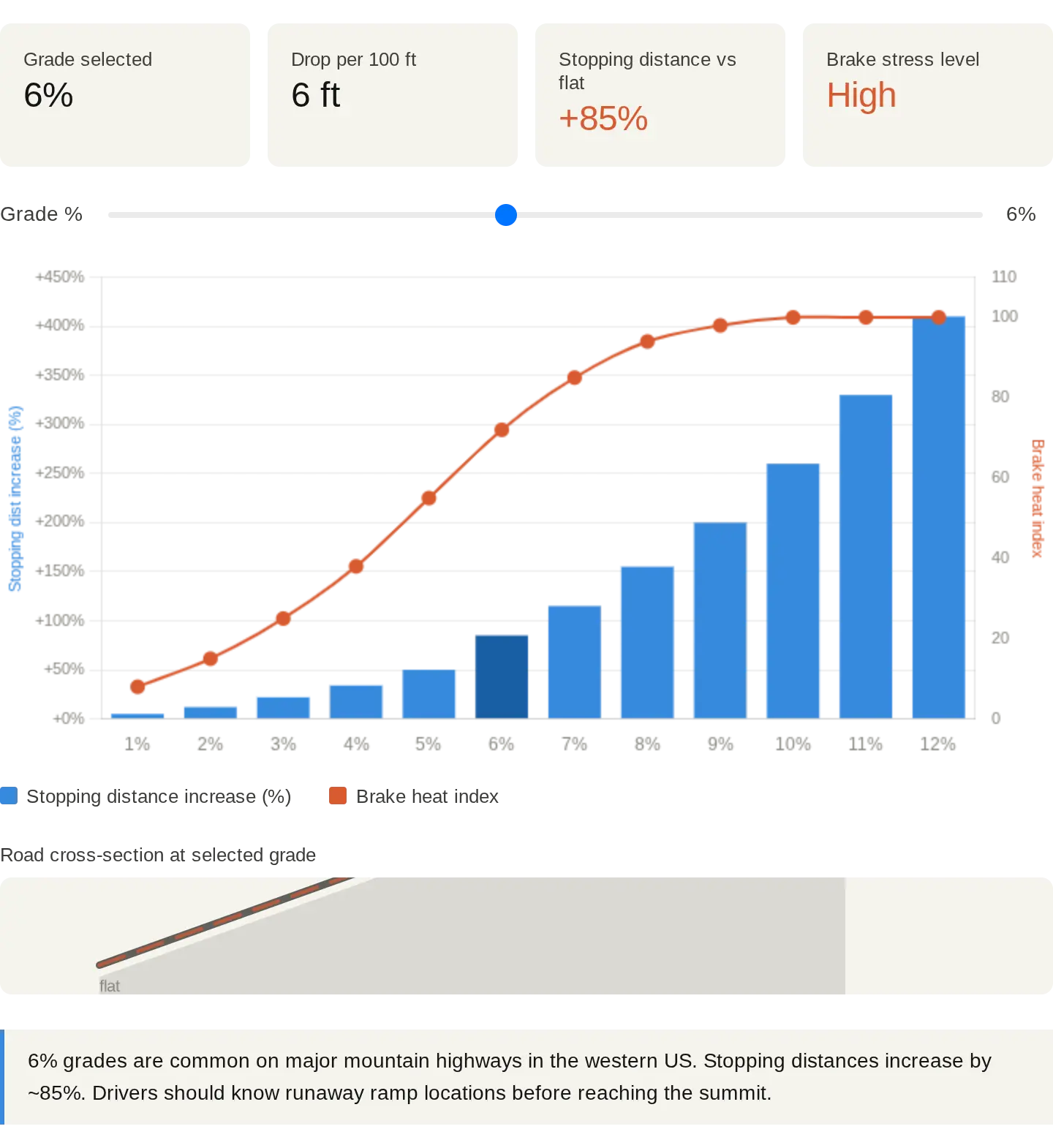
The chart above is the sort of thing the course makes concrete: stopping distance does not rise gently as a grade steepens, it climbs steeply, and brake heat climbs with it. Knowing the shape of that curve changes how early you set your speed at the top of a descent. For the full treatment, see The Physics of Safe Driving.
Who should take an advanced driving course
- CDL and commercial drivers facing mountain passes, long hauls across shifting weather, high crosswinds, and tight schedules
- Fleet and bus drivers who need a consistent professional standard and better decisions in low visibility and heavy traffic
- Everyday drivers who commute in rain, fog, or winter conditions, new residents in snow country, and anyone who wants to handle an emergency calmly
If you have had a close call, moved somewhere with harsher weather, or want to open up more routes and opportunities, advanced instruction pays off quickly.
Online learning that fits a real schedule
You do not need to park your career to level up your skills. Excell PDT’s online defensive driving course lets you train during layovers, evenings, or weekends. Progress saves automatically, so you can complete lessons in short segments and return exactly where you left off. Drivers most often report immediate gains in space management and wet-weather control.
If you want to build core safety skills without disrupting work, start with our commercial driver safety training for CDL and fleet drivers, or browse the full course catalog to see the adverse-weather and load-specific programs.
The on-road payoff
It shows up the first time conditions change. You will:
- Read the road earlier and set safer entry speeds before curves and downgrades
- Keep more margin in rain and wind, with smoother inputs that protect traction
- Recognise a developing skid and correct sooner, often before it becomes a visible slide
- Make clearer low-visibility calls about speed, spacing, and when to shut it down
Those behaviours reduce stress, improve schedule reliability, and prevent the kind of incident that derails a career.
Course length and what to expect
Length varies by program and by how you work. Many drivers finish the core modules over a few evenings or a couple of weekends; deeper specialty paths take longer. Each lesson stacks concepts in small steps with practical checkpoints. If you are unsure which path fits your goals, our team will help you choose.
FAQs
What do you do in an advanced driving course?
You practise traction control, downhill braking strategy, space and speed management in wind and rain, skid recognition and recovery on ice and snow, and clear decision making in low visibility — all anchored in vehicle dynamics and real scenarios.
Who should take an advanced driving course?
CDL holders, bus and fleet drivers, and everyday motorists who face bad weather, mountain routes, or a past close call. It is valuable for new drivers and for seasoned professionals who want more precision.
How long does it take?
Timelines vary by course and pace. Many learners finish core modules in short blocks over one to two weeks. Specialty tracks take longer. You can start any time and pause as needed.
Can CDL training be done online?
Partly. Core knowledge, physics-based decision making, hazard perception, and adverse-weather strategy all work well online. Hands-on vehicle operation still has to follow your state and employer requirements — but online training makes every mile behind the wheel more useful.
Take the next step
Advanced skills pay dividends in safety, confidence, and career options. Train on your own schedule, learn the physics behind control, and put it to work on your next drive. Enroll today, or explore the defensive driving course and advanced defensive driving options to find your starting point.